Tall Poppy Theory™
A research-informed decision framework for high-performing women navigating workplace bullying, harassment, targeting, and retaliation
47% of women whose responses became visible and attributable were fired within 12 months
The issue was not only which pathway they chose: Exit, Voice, Loyalty, or Neglect.
The issue was how visible and traceable their response became before identity, timing, and leverage were protected.
New research shows how response visibility may change career risk when standard workplace advice fails
A free field guide to what your options actually are, and what the research found about each one.
How Response Visibility Changes Risk
In this research, visibility matters:
overt (identity visible and attributable) vs.
covert (identity not immediately visible and attributable)
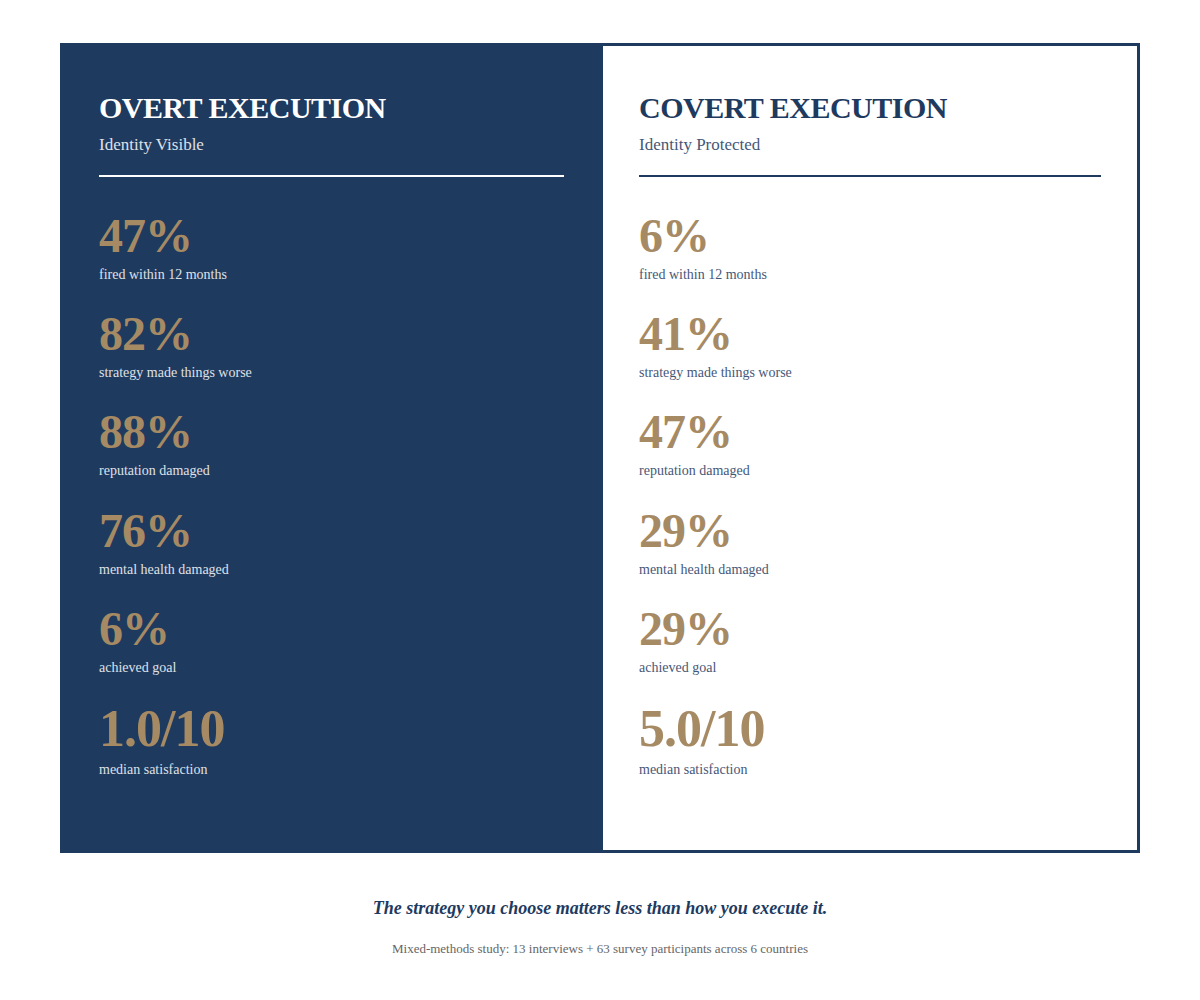

This research was presented at the IAWBH 2026 Conference in Canberra, Australia.
The moment I knew
“I thought it was a misunderstanding until colleagues pulled me aside. Then meetings stopped, whispers started, and I realised I was the target.”
Director of Public Policy, UK
HR was not confidential
“HR said it would be confidential. Within days the bully knew, allies turned cold, and every mistake was documented. I became the problem overnight.”
Bioengineer Lead, Australia
Protecting my identity
"I stopped feeding them information; they were using it against me. The pressure lifted a bit when I moved quietly and kept my plans to myself."
EVP Marketing, United States
You do not need more opinions. You need a clearer view of where you stand.
There are four ways women respond to this, which researchers identified decades ago: Exit, Voice, Loyalty, and Neglect (Hirschman 1970; Rusbult et al. 1988). You are almost certainly already doing one of them. The Workplace Targeting Playbook walks you through all four, what the research found about each, and the one factor that shaped outcomes more than the pathway itself: how visible your response became before you were ready.
Private. Research-informed. Built for women who are finished guessing.
The Framework
The Tall Poppy Theory™
There is an old saying: the tallest poppy gets cut first.
At work, it often looks like this: the women who deliver the most, raise the bar, and become highly visible may be targeted because their competence shifts the power balance.
The Tall Poppy Theory focuses on the moment after a woman realizes what is happening. It does not ask why bullying exists or how organizations should prevent it. It asks a more urgent question:
What changes the risk profile once institutional protection can no longer be assumed?
The data point to a counterintuitive pattern: outcome differences were more strongly associated with response visibility than with pathway choice alone. The question was not just what path a woman chose. It was whether the organization could see and attribute that response to her before she was ready.
The Playbook walks you through all four pathways and how visibility changed the risk attached to each one.
The distinction is not silence versus speaking up.
The distinction is overt versus covert visibility.
Pilot Study
What the Research Revealed
A mixed-methods study of high-performing women across six countries and multiple sectors revealed a pattern that challenges much of the conventional advice given to workplace bullying targets.
Participants pursued a range of response pathways. Some used formal channels. Some chose to leave. Some stayed. No single pathway guaranteed a good outcome.
One factor consistently accounted for the outcome differences in this sample: whether the response became visible to the organization and attributable to the target.
Execution visibility was more strongly associated with outcome differences than pathway choice alone.
Responses that became visible and attributable through formal channels were associated with higher rates of retaliation, isolation, and career damage in this sample.
The finding does not mean the complaints lacked merit. It means that once a response became visible and attributable, the risk profile changed.
Lower-visibility responses were associated with lower rates of damage to career, reputation, and well-being across the comparison groups.
This research does not argue for silence. It shows that visibility, timing, identity protection, and leverage changed the risk attached to each response pathway.
This research was presented at the International Association on Workplace Bullying and Harassment (IAWBH) 2026 Conference in Canberra, Australia. The IAWBH Conference is the premier international forum for workplace bullying scholarship.